Winfield Plan & Zoning Commission Hearing Ends Without Vote on Amazon Drone Proposals After Packed 3-Hour Session
GMedia Reporting | Oct 07, 2026
WINFIELD, Ill. — A marathon three-and-a-half-hour hearing before the Winfield Plan and Zoning Commission drew an overflow crowd of 45 to 60 local and regional residents Wednesday evening, as community opposition mounted against Amazon Prime Air’s proposal to launch commercial drone delivery operations out of its North Avenue fulfillment center.
The meeting, which ran from 7:00 p.m. to 10:20 p.m. at Winfield Village Hall. It concluded without a vote, as commissioners agreed to continue deliberations and potentially seek a larger venue for their next scheduled meeting on November 4.
Statutory Notices and Public Transparency Concerns
Procedural tension surfaced early after the commission quickly approved a routine exterior facade modification for a property on Jewell Road. Facing a packed boardroom and overflow crowd in the hallway, the village attorney invited attendees standing in the corridor inside to ensure clear hearing.
Commissioners addressed procedural logistics upfront, explaining that following consultation with legal counsel, they would maintain two distinct public hearings: Case 2026.05, covering proposed municipal code text definitions for “Delivery Drone” and “Delivery Drone Station,” and Case 2026.06, addressing a major amendment to the North Avenue Commerce Center Planned Unit Development (PUD) and special use permit for the site.
Multiple residents voiced frustration that the ordinance text definitions under consideration were not read aloud or distributed prior to public comments. Attendees also questioned how the meeting was publicized, stating they discovered the event through social media or word-of-mouth rather than village channels.
Village officials confirmed that legal public notice was published in the Daily Herald on September 21, 2026. Under the Illinois Municipal Code (65 ILCS 5/11-13-14 and 65 ILCS 5/11-13-1.1), local governments are statutorily required to publish zoning public hearing notices in a secular newspaper of general circulation published within the municipality or county at least 15 days prior to the hearing. While print publication satisfies state statutory baselines, current state law leaves municipal website or social media announcements discretionary.
“Progress has been slow on everything, but we’re rushing to put drones in the sky” one Winfield resident remarked during public comment, arguing the community was being used as a test bed before real-world long-term data is established. Another resident noted that citizens receive more direct municipal notification for rescheduled trash pickups than for proposed flight operations overhead.
Because Amazon’s proposed 7.5-mile delivery radius spans across municipal boundaries, residents from neighboring communities, including Wheaton, Carol Stream and Glendale Heights, also attended. Commissioners noted Amazon’s FAA filings listed surrounding municipal authorities and police departments, with neighboring communities such as Carol Stream and Glendale Heights issuing public updates regarding the filing.
Proposed Site Operations and Technical Specifications
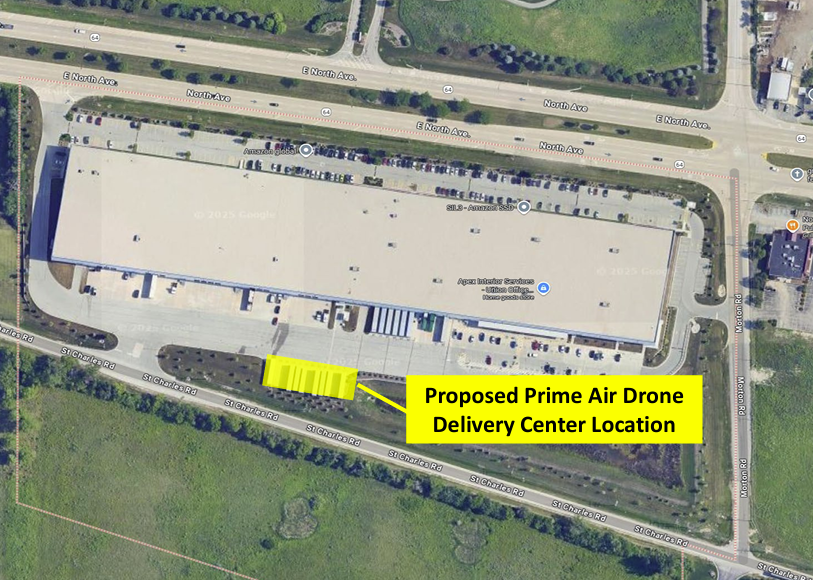
According to filing documents submitted to the commission by BL Companies and Amazon, the proposed Prime Air Drone Delivery Center (PADDC) would be installed in the southern parking area of the existing SIL3 fulfillment center at 27W501 North Avenue, Suite 100.
Site plans outline the installation of a concrete launch pad, modular battery vault charging stations (UL 1487 compliant), a dedicated weather antenna, sliding security gates, turnstiles, and Conex storage containers for spare parts and assembly. The modification involves a net loss of 12 trailer spaces and 4 loading dock doors, alongside an increase of 2,146 square feet of impervious surface.
Sam Bailey, Senior Manager of Economic Development Policy for Amazon, presented details on the operation:
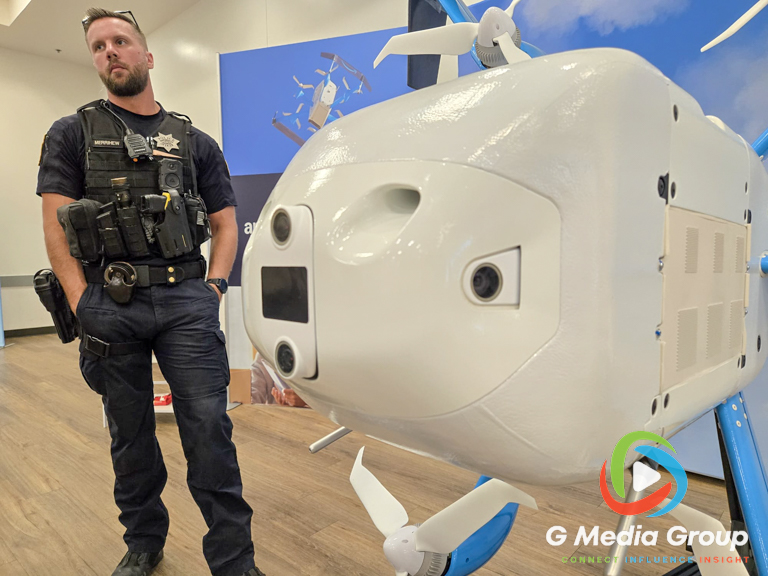
Fleet & Volume: The site would house 10 to 14 electric MK30 drones, operating 150 to 250 daily flights during civil twilight hours (30 minutes before sunrise to 30 minutes after sunset).
Capabilities: Drones carry up to 5-pound payloads within a 7.5-mile radius, targeting delivery times of 60 minutes or less. Drones drop packages from a 13-foot hover altitude without touching the ground.
Economic Impact: The facility currently employs approximately 400 workers; the drone operation would add about 30 new staff members, with Amazon assisting personnel in obtaining FAA Part 107 commercial remote pilot certifications.
Addressing noise concerns, Bailey referenced sound modeling and testing conducted at a dedicated test property. At its peak sound level during a 13-foot backyard delivery drop, the MK30 drone registered 68 dBA in the backyard and 61 dBA from the front yard. Presentation slides contextualized these figures against standard household noise levels, noting residential vacuums typically produce ~70 dBA and gas lawnmowers reach ~90 dBA. Operational sound at the launch pad ranges from 53 to 68 dBA, dropping to 52.8–54.7 dBA at 500 feet.
Safety Protocols and Contingencies
Commissioners reiterated throughout the evening that federal law assigns exclusive jurisdiction over navigable airspace to the Federal Aviation Administration (FAA), limiting local board purview strictly to ground-level land use and zoning.
When questioned about safety and past incidents, Bailey explained that commercial delivery drones operate under FAA Part 135 certification and are regulated under cargo aircraft standards, subject to NTSB oversight. He addressed two specific prior operational incidents:
Obstacle Collision: An incident investigated by the NTSB involving a crane constructed after Amazon’s daily rooftop visual sweep.
Property Impact: An incident where a drone clipped a multi family dwelling’s gutter and fell, causing $1,980 in property damage, which was fully reimbursed under Amazon’s liability coverage.
In the event of battery thermal issues or power dropping below 40%, Bailey detailed that the drone executes an vertical safe contingent landing into a green space. Drones cannot take off from a contingency landing spot and must be physically recovered by an Amazon team.
Community Sentiment and Next Steps
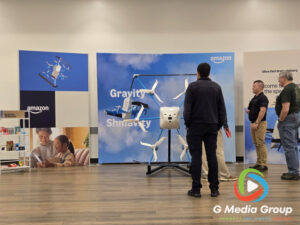
The overall atmosphere at Village Hall marked a stark contrast to an earlier public open house held on September 24 at the ARC Center in West Chicago, where community interactions were largely inquisitive and relaxed. Wednesday’s hearing was dominated by public skepticism regarding noise, privacy, safety, and local benefit.
One neighboring commercial property owner along North Avenue cautioned that low-altitude drone launches near heavily traveled roadways could create visual distractions for motorists, increasing collision risks.
A few residents offered more mixed views. One resident acknowledged possible utility, such as rapid one-hour delivery of cough medications. Another resident noted the limits of municipal authority, pointing out that denying ground launch permissions in Winfield would not prevent Amazon from launching drones from a neighboring town and flying through the same airspace under federal guidelines.
With public comments stretching past 10:00 p.m., the commission voted to defer commissioner discussion and votes until the next meeting on November 4, 2026. Officials indicated they will evaluate possible larger local venues to accommodate public attendance.