Amazon Prime Air in Winfield and West Chicago
A Complete Guide to the FAA Filings, Zoning Process, and Aviation Facts
Zachary Gebis | November 16, 2026
Proposals to launch commercial Amazon Prime Air drone deliveries from the company’s existing fulfillment facility at 27W501 North Ave, a parcel straddling the border of Winfield and West Chicago, have sparked intense debate across DuPage County social media groups and municipal hearings. Between viral neighborhood posts, complex federal aviation terminology, and multi-agency hearings, verifiable facts have often been drowned out by speculation.
This guide serves as a centralized reference for residents across Winfield, West Chicago, Carol Stream, Wheaton, Glendale Heights, and surrounding communities. Every technical specification, noise measurement, and regulatory status below is sourced directly from public filings with the Federal Aviation Administration (FAA), the National Transportation Safety Board (NTSB), and the Village of Winfield.
Where the Amazon Drone Project Actually Stands: Two Separate Approvals
The single biggest source of confusion in local discussions comes from blending together what the Village of Winfield controls versus what the Federal Aviation Administration (FAA) controls. Amazon’s plan to operate commercial delivery aircraft out of its existing warehouse at 27W501 North Ave (designated in federal filings as Prime Air Drone Delivery Center SIL3) cannot move forward without two completely separate government approvals:
Local Municipal Land-Use Approval from the Village of Winfield for ground-level construction and zoning.
Federal Airspace and Environmental Authorization from the FAA for flight operations.
Neither agency can override the other’s jurisdiction, and as of publication of this article, neither agency has granted final approval for the Winfield/West Chicago site.
Local Municipal Zoning: Village of Winfield
(Cases 2026.05 & 2026.06)
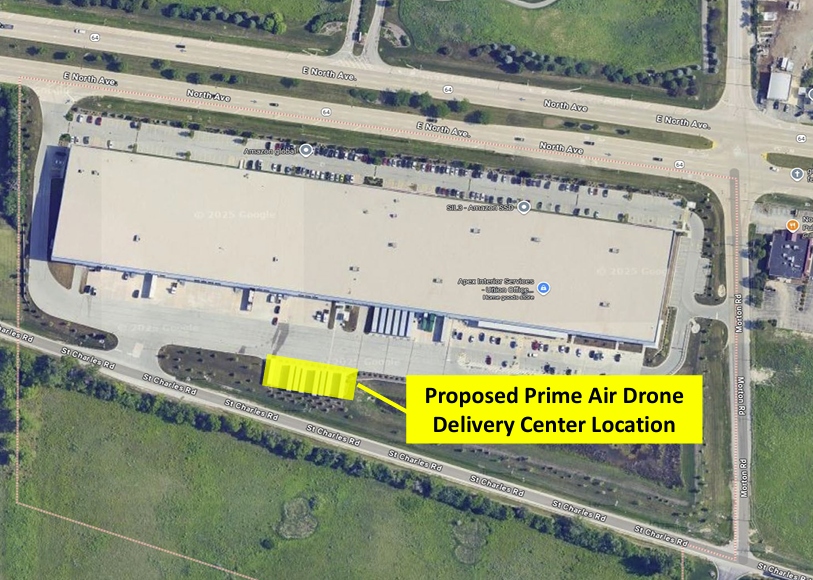
Although 27W501 North Ave. carries a West Chicago postal address, the property lies inside the corporate limits of the Village of Winfield. In August 2026, the Winfield Village Board classified Amazon’s request to build an exterior drone launch, landing, and staging pad (referred to in site plans as a “paddock”) on the south side of the warehouse as a major zoning amendment.
What is on the Table: The Winfield Plan & Zoning Commission is reviewing two formal applications: Case 2026.05, which amends the village zoning code to define “Delivery Drone” and “Delivery Drone Station,” and Case 2026.06, which requests a major amendment to the North Avenue Commerce Center Planned Unit Development (PUD) along with a Special Use Permit.
Current Hearing Status: Following a packed, three-hour public hearing on Oct. 7, 2026, commissioners deferred a vote to Nov. 4, 2026. That Nov. 4 session was subsequently postponed at request from Amazon, with deliberations currently expected to resume in January 2027.
Where Municipal Authority Stops: Under federal aviation law and Illinois statutory frameworks, municipal governments regulate ground-level land use, meaning site layout, impervious surface limits, screening, parking, and zoning compliance. Neither Winfield nor any neighboring municipality has legal jurisdiction over navigable airspace, flight altitudes, or aerial routes once an aircraft leaves the ground. Even after the Plan & Zoning Commission eventually issues a recommendation, final local approval still requires a public vote by the Winfield Village Board of Trustees.
Federal Airspace & Environmental Review: FAA Chicago Docket
Separate from Winfield’s zoning board, the FAA’s Flight Standards Service (General Aviation and Commercial Branch, AFS-752) conducted a federal environmental review under the National Environmental Policy Act (NEPA) covering proposed Prime Air operations across multiple Chicago-area Amazon facilities—including SIL3 in West Chicago/Winfield, IGQ1 in Markham, ORD5 in Matteson, and MAE3 in Morton Grove (Source: FAA Draft Environmental Assessment for Amazon Prime Air Package Delivery Operations in Chicago, Illinois, July 2026).
Current Federal Filing Status: The FAA published its Draft Environmental Assessment (EA) on July 15, 2026, and held a 30-day public comment period that closed on Aug. 14, 2026 (Source: FAA UAS NEPA Repository, AMZ-CHICAGO Docket). Under NEPA regulations, the FAA must review and publish formal written responses to every submitted public comment before it can issue a Final Environmental Assessment and a Finding of No Significant Impact (FONSI). As of mid-November 2026, the Chicago docket remains in Draft EA status on
faa.gov.Two Keys Required to Turn the Lock: Even if the FAA issues a Final EA and FONSI, Amazon cannot build or operate the launch pad at 27W501 North Ave, if the Village of Winfield denies the zoning amendment. Conversely, even if Winfield approves the ground-level zoning, Amazon cannot legally launch a single commercial flight until the FAA grants final environmental and operational sign-off.
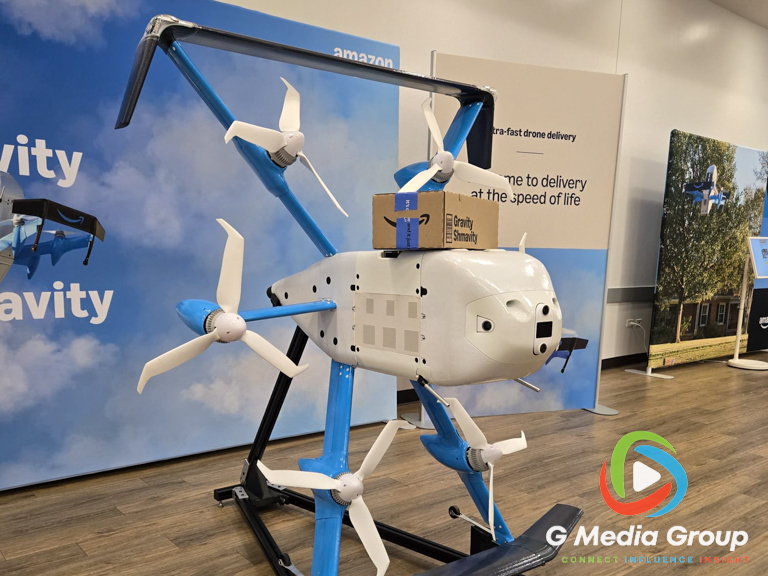
Why the MK30 Looks Like That: Hybrid VTOL Aircraft Explained
A widely shared social media template circulating in DuPage County groups warns residents: “These are 80lb massive 5.5ft x 5.5ft commissioned to carry packages up to 5lbs.“ To anyone who has never studied aerodynamics, carrying a 5-pound parcel on an 80-pound aircraft sounds wildly inefficient.
In aviation engineering, those dimensions are intentional and exist for one reason: transitioning from a helicopter into an airplane.
Not a Retail Toy Quadcopter: Consumer drones bought at retail stores typically weigh between 0.55 and 2 pounds and rely strictly on spinning rotors pushing air downward to stay aloft. Hovering continuously drains batteries rapidly.
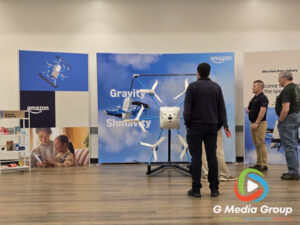
Hybrid Vertical Takeoff and Landing (VTOL): The Amazon MK30 measures roughly 5.5 feet in diameter/span (5.6 feet max dimension per FAA acoustic filings) and weighs 78 pounds empty / 83 pounds maximum takeoff weight. It uses six propellers mounted on an airframe equipped with fixed lifting wings.
How It Flies: The MK30 lifts off vertically like a helicopter up to roughly 115 to 132 feet above ground level (AGL), then tilts forward and transitions into horizontal, wing-borne flight. Once cruising at 180 to 279 feet AGL outbound (and 279 to 377 feet AGL inbound) at roughly 62 to 67 mph (58.3 knots), its fixed wings generate aerodynamic lift just like a small propeller airplane. That structural wing airframe, triple-redundant flight computers, obstacle sensors, and high-capacity lithium-ion battery pack account for the ~80-pound aircraft weight.
Part 135 Air Carrier Rules vs. Hobbyist Drone Rules
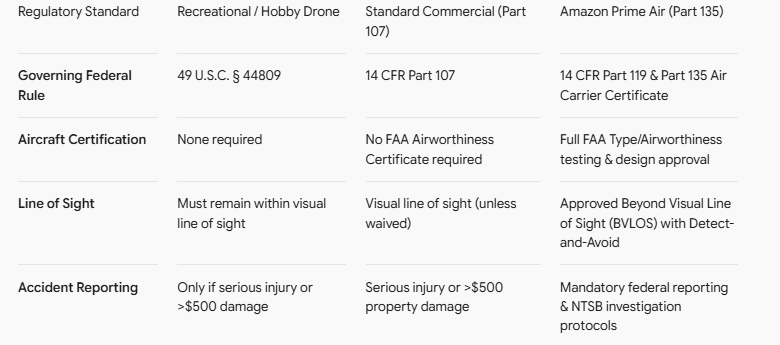
Many residents assume Amazon is flying under the same rules as a hobbyist flying a camera drone at a local park. In reality, Prime Air operates under Title 14 of the Code of Federal Regulations (14 CFR) Part 135, the exact same federal air carrier regulatory framework governing commercial commuter airlines and charter cargo operators.
Translating Aviation Jargon: What “Aircraft Down” Actually Means
When viral posts or out-of-state articles cite federal incident logs from Prime Air test cities, readers frequently see the phrase “Aircraft Down” and assume an 80-pound drone fell out of the sky onto a roof.
In aviation terminology, an “aircraft down” event simply means an aircraft landed anywhere outside its pre-designated home landing pad. The MK30 is programmed with conservative autonomous contingency logic. If onboard telemetry detects an unexpected wind gust, a battery cell variance, a communications hiccup, or an obstacle in the delivery yard, the aircraft is programmed not to gamble on a return trip back to the hub. Instead, it enters a controlled hover, uses downward optical and LiDAR sensors to locate an open, unobstructed grassy patch, and performs a vertical landing. Because the MK30 is prohibited from relaunching autonomously from an unverified field, a ground recovery crew drives out to retrieve it, logging the event in federal records as an “aircraft down” recovery.
Actual incidents do still occur and are part of the public federal record. For example, in earlier operations outside Illinois, the National Transportation Safety Board (NTSB) investigated a collision in which an MK30 struck a mobile crane erected after Amazon’s morning visual route sweep, as well as a separate incident where a drone clipped a multi-family building’s gutter, resulting in $1,980 in property damage reimbursed by Amazon. Because Prime Air holds a Part 135 air carrier certificate, every such incident triggers mandatory federal reporting and independent NTSB review.
Noise Pollution: What the FAA Acoustic Studies Actually Measure
Concerns about constant buzzing over neighborhoods, sporting events, and forest preserves are the top issue raised at local hearings. To measure sound objectively rather than guessing, an independent acoustic engineering study was conducted (Estimated Noise Levels for Amazon Prime Air MK30 Drone, Appendix E of the FAA Environmental Assessment, prepared by Environmental Science Associates).
Measured Decibel Levels by Flight Phase
Overhead Cruising Flight: When flying horizontally at its typical outbound cruising altitude of 200 feet AGL at 62–67 mph, the FAA study models a Sound Exposure Level (SEL) of 63.7 dB (with peak instantaneous noise around 60 to 61 dB). On the return flight at 345 feet AGL (after dropping the package), the SEL drops to 60.9 dB. According to the FAA’s acoustic benchmarks, 60 to 64 dB on the ground is equivalent to a standard window air conditioner at 100 feet, a normal conversation, or light suburban street traffic, and the aircraft is visible and audible to a ground observer for less than 4 seconds as it passes overhead.
Backyard Package Delivery: During an actual delivery, the MK30 slows to zero forward speed, descends vertically to a 13-foot hover, lowers the package without touching the ground, and ascends upwards. That entire delivery sequence lasts under one minute and generates approximately 69 dB at 75 feet (comparable to a household vacuum cleaner at 10 feet, or a peak SEL of 92.1 dB directly at 25 feet from the drop pad for roughly 30 seconds). Across residential neighborhoods as a whole, the FAA models Day-Night Average Sound Levels at 46 to 48.1 dB, well below the FAA’s 65 dB DNL threshold for significant noise impact.
At the North Avenue Launch Pad (SIL3): Site plans filed with Winfield show operational sound at the launch paddock ranging from 53 to 68 dBA on-site (with test-range peak measurements reaching 82 dBA at 20 feet during liftoff), attenuating to 52.8 to 54.7 dBA at 500 feet from the pad, comparable to existing daytime road noise along North Avenue (Illinois Route 64).
Hours & Flight Caps: The FAA environmental assessment restricts flights strictly to 6:00 a.m. through 10:30 p.m. (no overnight operations). While the maximum theoretical ceiling modeled in the FAA filing is up to 1,000 deliveries per day at full long-term maturity, comparable hubs in initial rollout phases operate at a small fraction of that ceiling. Amazon representative Sam Bailey testified under oath during the hearing that the expected flights per day to be about a fraction of such at around 250-300 per day and deliveries will only occur during daylight.
Economic Impact and Job Creation: What the Amazon Positions Entail
Beyond the logistics and airspace discussions, the Amazon Prime Air proposal carries significant local employment impacts. Public testimony from Amazon representative Sam Bailey during municipal hearings, combined with active regional job postings for Illinois facilities (such as Matteson and Harvey), provide a clear picture of the workforce required to run a drone delivery hub.
New On-Site Specialized Roles and Pay Rates
Rather than automating away human labor, operating a drone delivery hub introduces specialized, high-paying local jobs based directly at the facility:
Flight Monitor, Amazon Prime Air: Active job postings in Illinois (such as Matteson) list starting pay at $35 per hour. Amazon representatives testified during municipal proceedings that these roles require an FAA Part 107 Remote Pilot Certificate. For candidates who do not yet hold the certificate, Amazon has testified that the company covers the training and certification costs, with testing conducted through an FAA-authorized local flight school. These are strictly on-site operational roles and required by FAA regulations.
Prime Air Ground Handler: Regional job postings in Illinois (such as Harvey) list starting pay at $27 per hour. Ground handlers are responsible for on-site facility logistics, aircraft maintenance support, battery management, and preparing packages for drone loading. These positions are also permanently on-site.
Headcount Increase and Facility Integration
A common local concern is whether automation will result in layoffs or a reduction in existing warehouse staff. Amazon explicitly testified that Prime Air operations will not reduce headcount at the existing facility; instead, the integration will increase overall headcount by adding skilled aviation monitoring and ground-handling personnel to the existing workforce.
Optional Service, Not a Truck Replacement
It is also vital to understand how Prime Air fits into Amazon’s broader delivery network:
Strictly Opt-In: Drone delivery is an optional service. It does not replace standard home delivery or alter neighborhood traffic for traditional delivery vans unless a resident specifically chooses to enroll.
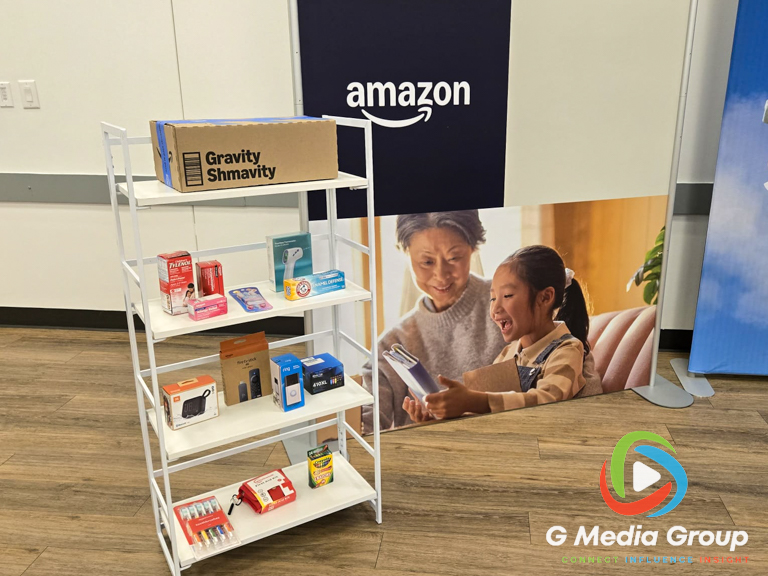
Complementary, Not a Replacement: Prime Air is designed exclusively for lightweight, urgent parcels (5 pounds or less, such as small household goods, medication, or urgent essentials). It is not a replacement for semi-truck freight, standard fulfillment center logistics, or “last-mile” delivery routes driven by independent couriers and delivery drivers. Item selection is also limited to items in stock at the Winfield location and not all items housed are eligible for drone delivery. SIL3 is a sub same day (SSD) Amazon fulfillment center. Stores 100,000+ items of the most ordered customer products in the region.
- Comes at an additional cost: Amazon has stated that deliveries by Drone will be considered a “premium service” at an additional cost up to $5.99 per delivery and is not included as part of Prime free shipping.
What Is an FAA Part 107 Remote Pilot Certificate?
Airspace Deconfliction (DuPage Airport & Medical Helicopters)
With DuPage Airport (DPA) sitting just a few miles west in West Chicago and medical helicopters flying regularly to Northwestern Medicine Central DuPage Hospital (CDH) right in Winfield, local aviation safety is a major, legitimate question for readers.
How They Stay Separated: Commercial manned aircraft and medical helicopters generally operate at or above 500 to 1,000+ feet AGL (except when taking off or landing at an airport or helipad), whereas MK30 drones cruise strictly between 180 and 377 feet AGL. Amazon has also testified that there will be a “no fly zone” around the heliport at CDH at all time so that life flights are not impacted, as well as the flight pathways into and out of DuPage Airport.
Detect-and-Avoid & ADS-B: The MK30 uses onboard acoustic, optical, and radar/LiDAR Detect-and-Avoid (DAA) sensors to detect manned aircraft, including low-flying helicopters that may not be broadcasting ADS-B, and automatically yields right-of-way by descending or holding position until the airspace is clear.
How a Prime Air Delivery Actually Works: Step-by-Step
A major misconception circulating online is that Amazon drones will randomly fly down streets dropping boxes onto front porches, leaving packages vulnerable to theft or falling on unsuspecting passersby. In reality, Prime Air functions much like an on-demand private courier strictly opt-in, scheduled to the minute, and governed by automated obstacle sensors.
It Is a Paid, Strictly Opt-In Service (Not Default Prime)
Prime Air is not an automatic default for standard Amazon Prime orders. Customers must explicitly choose drone delivery at checkout, paying an “ultrafast” delivery fee. Because customers actively select and pay for same-hour delivery, they know the aircraft is enroute and receive live, down-to-the-minute app notifications as the drone approaches.
Pre-Selected Yard Zones via Interactive Map (Not Front Porches)
Drones never land on or drop packages onto front porches, roadways, parking lots, or public sidewalks. During enrollment, the customer uses an interactive aerial map in the Amazon app to select a pre-vetted, unobstructed grassy drop zone typically in their front yard, backyard, or side yard.
Overhead Clearance Checks: Before a yard is approved, Amazon’s mapping team and the MK30’s downward sensors verify that the drop zone is completely clear of overhead hazards, including utility power lines, tree canopies, and low-lying residential cables such as backyard bistro string lights.
Why the Drone Hovers at 13 Feet (And Never Touches the Ground)
When the MK30 arrives above the pre-selected grassy spot, it slows to a stationary hover at approximately 13 feet (4 meters) above ground level. It never lands in the customer’s yard.
Out of Human Reach: Maintaining a 13-foot altitude ensures that spinning propellers remain completely out of reach of adults, children, and pets on the ground.
Engineered Drop Safety: From 13 feet, the aircraft opens its payload bay and releases the padded box. Only lightweight, durable items weighing 5 pounds or less (roughly able to fit in the size of a large shoebox such as medication, chargers, or household essentials) are eligible, and packages are padded to survive the short 13-foot drop. Federal aviation risk assessments and impact modeling specifically evaluate the kinetic energy of a 5-pound parcel from 13 feet to ensure drop zones and payload weights remain within strict safety thresholds.
Real-Time Movement Detection, Aborted Drops, and Account Blacklisting
During the entire descent and hover, the MK30’s downward-facing cameras and LiDAR sensors continuously scan the ground below for any movement, including pets, children, vehicles, or adults walking toward the drop zone.
Instant Abort: If the sensors detect a person or animal entering the drop area underneath the aircraft, the drone immediately aborts the delivery, closes its bay doors, climbs back to cruising altitude, and returns to the hub. The customer is notified that their order will instead be delivered by traditional ground courier.
No Catching Packages: Customers are explicitly instructed to stay indoors until the drone departs. In existing launch markets, attempting to walk under the hovering aircraft or catch a falling box triggers an immediate sensor abort, and it’s been rumored that repeated safety violations or tampering with or being inside of an active drop zone can result in Amazon revoking drone delivery eligibility for that address and blacklisting the property from future Prime Air service.
Immediate Retrieval (Why “Porch Piracy” Isn’t the Issue People Fear)
Critics on social media have raised alarms that front-yard drone drops will invite rampant package theft. In practice, because Prime Air deliveries arrive within 60 minutes of ordering and send real-time arrival alerts to the buyer’s phone, customers are actively watching for the drop and typically walk outside to retrieve their package within seconds of the drone climbing away.
What We Still Don't Know
What Will Average Daily Flight Volumes Actually Look Like?
How Closely Will Real-World Operations Match the Assumptions Used in Federal Review?
What Will Long-Term Customer Adoption Look Like?
How Might Operations Change in the Future?
Some Questions Are Policy Questions Rather Than Factual Ones
The Bottom Line
Point-by-Point Fact Check of the Viral Social Media Post
A copy-and-paste post circulating across local Facebook groups urges residents to oppose the project based on several specific claims. Below is how each claim compares against verified public records:
Claim 1: “Amazon would like to deploy drones from our Winfield warehouse to nearly the entirety of DuPage County.”
The Facts: According to the FAA’s Chicago Environmental Assessment (Appendix G), the maximum operating range of the MK30 from the SIL3 facility is a 7.5-mile radius (approximately 175 square miles). While that circle covers parts of Winfield, West Chicago, Wheaton, Carol Stream, Warrenville, Glendale Heights, Bloomingdale, St. Charles, and Geneva, it leaves out large portions of eastern and southern DuPage County (such as Elmhurst, Hinsdale, Downers Grove, Woodridge, Darien, and much of Naperville). Furthermore, delivery eligibility inside that 7.5-mile ring is limited strictly to customers who opt in and whose yards pass an aerial obstacle clearance audit. The final deliverable area also will maintain cut outs around life flight operations such as Central DuPage hospital as well as cut outs for airport runway traffic such as DuPage Airport.
Claim 2: “Winfield is about to make a major decision… and I feel they are not allowing neighboring cities to weigh in.”
The Facts: Winfield’s public hearings are open to public comment regardless of municipal residency, and residents from neighboring towns spoke at the Oct. 7 hearing. More importantly, Winfield is only voting on whether a warehouse inside Winfield’s industrial park can build a ground-level launch pad. Under federal law, neither Winfield nor any neighboring city has authority over FAA-regulated airspace, and the FAA separately conducted a federal comment period open to all residents and neighboring municipalities through Aug. 14, 2026.
Claim 3: “Gateway device for mass surveillance.”
The Facts: The MK30 carries downward- and forward-facing optical cameras and LiDAR sensors, but they operate as a closed-loop Detect-and-Avoid (DAA) safety system. Their sole purpose is to detect power lines, tree branches, pets, people, or vehicles in a customer’s drop zone so the aircraft can abort a delivery if the area is not clear. During Amazon’s Sept. 24, 2026 public open house at the ARC in West Chicago, local police officers, including Naperville Police representatives, questioned Amazon engineers specifically on camera recording and data retention. Officers confirmed that the MK30 processes obstacle data in real time and does not store, archive, or stream video footage for surveillance or third-party distribution.
Claim 4: “Disturb and drive away our wildlife.”
The Facts: In its July 2026 Draft EA and programmatic environmental findings, the FAA concluded that because MK30 overflights occur at 180 to 377 feet AGL, pass any given spot in under four seconds, and involve no ground clearing, any startle response by birds or wildlife in forest preserves and parks is brief and temporary. However, independent wildlife biologists interviewed regarding Amazon’s Nampa, Idaho facility have noted that concentrated flight corridors directly adjacent to a launch pad where departures and arrivals funnel through the same airspace warrant ongoing observation for localized bird nesting behavior.
Claim 5: “Distract our drivers” and “Distract our children.”
The Facts: Per FAA flight profiles, MK30 drones do not hover over streets, schools, or athletic fields. They cross roadways and public spaces at cruising altitudes of 180 to 377 feet AGL (roughly the height of an 18- to 35-story building) at 62–67 mph, remaining visible to an observer on the ground for less than four seconds. Deliveries are geo-fenced exclusively to pre-vetted residential yards, not schools, parks, or roadways.
Claim 6: “Decrease our property value.”
The Facts: Because Part 135 commercial drone delivery only began operating in select U.S. markets between 2024 and 2026, there is zero peer-reviewed real estate or appraisal data demonstrating that drone delivery corridors lower suburban home values. Additionally, the SIL3 site at 27W501 North Ave. is already a zoned industrial logistics warehouse employing roughly 400 people along a four-lane state highway (Illinois Route 64).
The Glover Team provides real estate services throughout Downers Grove and the western suburbs. Downers Grove Relator Sabrina Glover states on her website:
“There is currently no evidence that access to Amazon drone delivery has a measurable effect on home values, and it would be premature to suggest otherwise. The more interesting real estate story is how quickly the definition of convenience is changing for suburban buyers. When buyers compare homes in Downers Grove and surrounding communities, they already consider factors such as Metra access, commute times, schools, parks, downtown amenities, restaurants, shopping and proximity to major roads. Technology is increasingly becoming part of that equation. Same-day delivery, remote work, smart-home technology, electric vehicle charging and now potentially drone delivery are changing how people interact with their homes. Drone delivery itself is unlikely to determine where someone buys a house. But the continued investment in services designed specifically around suburban households reinforces a broader trend: buyers increasingly value homes and communities that make everyday life easier.“
Claim 7: “Citizens in other rollout areas are saying it’s a nightmare and they are trapped in their decision.”
The Facts: Because Amazon began testing and scaling commercial Prime Air operations in select U.S. markets, notably College Station, Texas, and parts of the Phoenix, Arizona metro area, between 2022 and 2024, those communities offer a real-world look at how drone delivery actually integrates into daily suburban life. Independent local reporting, municipal council records, and resident interviews from those test markets reveal a nuanced picture rather than a blanket “nightmare”:
The Noise Reality: In early rollout zones, residents living directly underneath primary approach and departure funnels closer to the fulfillment hubs have reported hearing a distinct high-pitched buzzing during peak delivery hours. However, for homes located even a few hundred feet away from designated flight paths, ambient neighborhood noise (traffic, lawnmowers, air conditioners) typically masks the transit sound entirely.
Property Rights and “Trapped” Claims: The idea that residents are “trapped” stems from federal preemption. Because the FAA controls navigable airspace, local homeowners cannot legally block drones from flying over their property if the flight paths are approved by the federal government. However, participation in the actual delivery service remains strictly voluntary: homeowners must explicitly opt-in and have their yards cleared for a drop zone before Amazon will ever deliver a package to their property. If a resident does not sign up, no packages are delivered to them.
The Local Context in Winfield: Unlike early test markets where drone operations were introduced into newly built suburban footprints with little advance notice, the SIL3 proposal in Winfield/West Chicago is undergoing a rigorous, multi-tiered public zoning review before a single flight takes place. Residents in Winfield, West Chicago, and surrounding DuPage communities still have active opportunities to voice concerns, question officials, and shape local conditions through the Winfield Plan & Zoning Commission and Village Board hearings.
Public Documents & External Resources Directory
To review the primary source materials referenced in this guide, access the official government dockets, municipal filings, and independent coverage below:
FAA UAS NEPA Environmental Repository: Access the official federal docket, notice of availability, and project reviews at the FAA NEPA and Drones Portal.
FAA Chicago Draft Environmental Assessment & Appendices:
- Review Draft EA for Amazon Prime Air Package Delivery Operations in Chicago, Illinois (PDF)
- Appendix A: Notice of Availability (PDF)
- Appendix B: Biological Resources and Agency Consultation (PDF)
- Appendix C: Section 4(f) and 6(f) Resources (PDF)
- Appendix D-1: Section 106 Resources and Agency Consultation (PDF)
- Appendix D-2: Tribal Consultation (PDF)
- Appendix E: Technical Noise Report (PDF)
- Appendix G: Coastal Resources (PDF)
Village of Winfield Plan & Zoning Commission: Review meeting packets, case files for Cases 2026.05 and 2026.06, site plans, and Amazon zoning exhibits at the Village of Winfield Official Website.
- 20261007-PZC-Packet-PDF
- A video replay of this meeting had been requested by GMedia Group under the Illinois Freedom of Information Act (FOIA) on November 14, 2026. A Village executive assistant, Kathy Lamela responded November 17, 2026 that “The Village only has video recordings of Village Board meetings.” The Village did however provide an audio recording of the zoning meeting as part of our request with it’s response.
- NTSB Incidents:
- WPR25LA103 Final Report – Accident Data – NTSB
- The UAS detected the drone and descended. During the descent the UAS struck the cart and came to a stop on the ground near the cart.
- WPR26LA002 Preliminary Report – Accident Data – NTSB
- There were no injuries. The unmanned aircraft system (UAS) report of a UAS collision with a mobile crane.
- WPR25LA103 Final Report – Accident Data – NTSB
- Village of Winfield Initial Board Meeting Video Replay (Aug 6, 2026)
- Begins at the 15:24 timemark – Sam Baily of Amazon presents to the village board the project scope and specifications and provides details regarding the operations at the SIL3 facility.
GMedia Group Local Reporting: Read field reports and coverage of local hearings, including Winfield Pauses Amazon Drone Delivery Proposal and the West Chicago Open House Coverage.
- Legacy Media Reporting:
- NBC5 Natalie Martinez reports Video Segment “West suburban residents push back on Amazon drone delivery” (YouTube)
- This video reports on the initial zoning public hearing in Winfield, regarding Amazon’s plan to launch drone delivery services from SIL3
- NBC5 Amazon to expand drone delivery of certain packages to Chicago suburbs PJ Randhawa reports (YouTube)
- NBC5 Natalie Martinez reports Video Segment “West suburban residents push back on Amazon drone delivery” (YouTube)